Showing posts with label non-surgical. Show all posts

Monday, November 1, 2010

Lip Augmentation

Full, luscious lips are thought of as a sign of youth. If you are looking to take a few years off your appearance, perhaps some lip enhancement can help you. This is a delicate procedure because, as I have mentioned before, even small changes to your face can change your appearance a great deal. However, lip enhancement is a GREAT choice for those who are unsure of what they want. This can be a temporary or permanent procedure and thus it allows you to figure out what you want. Over time, a very large variety of substances have been used. Some work better than others, and today there are a few main fillers that you can choose from.


One important thing to know is that you should not get lip injections done within 6 months of taking the acne medication Accutane. You should also not get the injections if you plan on starting to take Accutane within 6 months. This medication has been shown to increase certain scarring, and you definitely do not want that! Also, discuss any active diseases that you have (like diabetes) because these can affect how your injections come out.


Lip augmentation can be surgical (using implants) or nonsurgical (using injections).
Lip implants can include: dermis grafts (skin grafts), fascia grafts (fascia is a type of connective tissue in the body), tendon grafts, AlloDerm, and Gore-Tex.

                Alloderm is a dermis graft that comes from human cadavers—it does not last very long, and is fairly expensive so I would advise you to look at the other options before deciding on this one.

                Gore-Tex implants are nice because they are permanent but they are reversible. So if something goes wrong, you are able to fix it. They are made from expanded polytetrafluoroethylene, aka ePTFE. This material is not toxic and will support tissue incorporation so it will definitely seem natural.

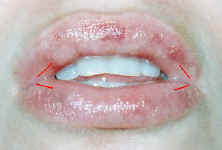
The incisions for this surgery are made right on the corners of your lips. Lips are highly vascular and have a fantastic blood supply so they will heal very quickly! This image shows you where the cuts are made:

Lip injections include: human/porcine/bovine collagen, and restylane.

                Most of the available injections are TEMPORARY. Collagen will last for about 3 or 4 months. Before you get collagen injections, make sure that you have a skin allergy test! Permanent injectable materials are rare, but you can  look in to Artecoll or Aquamid for example.

Restylane is a very popular choice today; it is used for lip injections as well as for filling in fine lines on the face. The recovery time is VERY fast (about 2 days) and you will need to have injections done again about every 6 months.


Here is a very nice example of a lip augmentation. You want to make sure to be modest with the size increase and to keep the lips proportional, otherwise you risk looking unnatural and duck-like, or worse.


People chose either injections or implants for a variety of reasons. Injections are known to give lips a more pouty appearance than implants do, so if that is what you are looking for injections might be the better choice for you. Another major thing to think about is how long you want this to last. If you are just flirting with the idea of having fuller lips, be sure to go with something that will wear off in a few months.


It is extremely important to find somebody with LOTS of experience doing this procedure, especially if you are having something permanent done. Everybody has seen what a bad lip augmentation looks like, and if you haven’t take a look at Lisa Rinna’s lips—she was pretty much the poster girl for lip augmentation gone wrong.


Thursday, October 28, 2010

Rhinoplasty

Rhinoplasty, a nose job, is one of the most common procedures available today. This procedure is very delicate and even minor changes to your nose can drastically alter your appearance. Anything done on your face must be done very carefully simply because the face is the first thing people notice; nobody sees a few lumps on your thighs unless they are looking closely, but a hooked nose is definitely something people pick up. Rhinoplasty can be done for purely aesthetic reasons, or it can be done to improve functionality.


Reconstructive rhinoplasty often performed in conjunction with a septoplasty; this is designed to repair a damaged or uneven septum and restore your ability to breathe through your nose. Even a small trauma as a child could cause a deviation in your septum, and you may not even realize it is there until you get it fixed and realize how much better you can breathe. Other times, deviations can be accompanied by noticeable outer deformities (like bumps and crookedness). These problems can all be fixed in the same procedure. When you visit your doctor, make sure that you explain to him any troubles you have with your breathing. Oftentimes, insurance will pay for some (or even all, if you’re lucky) of the cost of the surgery if it repairs breathing ability. Overall, reconstructive and cosmetic procedures are quite similar. Unless you have had some severe trauma that has greatly damaged the underlying structure, they will all follow the same pattern.


A rhinoplasty may be open or closed. Open refers to having an incision across the skin between nostrils as well as inside the nostrils, while closed refers to incisions just inside the nostrils. Speak with your doctor about the results you would like to see, that is what will determine your incision type. Keep in mind that an open rhinoplasty will have a visible incision line, but it will not likely leave a noticeable scar. As you can see below, the scars in the nostril will be completely undetectable and there is only a tiny incision outside of the nose.


The first thing that your surgeon will do after he has made his incisions, will be to start working on removing the bump portion—if that is what you had discussed. Part of the bump is made of cartilage and part is made of bone. The cartilage portion can easily be removed with a scalpel but the bone section will require the use of a chisel like instrument. The doctor will then perfect the bridge of the nose using a file to fine-tune his work. Next, he will work to refine the tip of the nose. This can be done via a variety of methods, all depending on what you want altered and what is causing it. Common methods involve cutting out portions of cartilage from the tip or even suturing the tip closer together to make it narrower.

Here is the tricky part, if the bridge of the nose is too wide, or needs to be reshaped; the doctor will break the bones in order to reshape them properly. Below is a GREAT image that helps explain this without having to know a great deal of technical terminology. The bones on the outside will be broken which allows the doctor to move them into a position that makes the bridge smaller and places it in a better position.


If you are interested in altering the appearance of your nose but do not want to go the “full” surgery route, you can try for a modified rhinoplasty or a non-surgical one. A modified rhinoplasty is when the doctor one removes the bump portion of the nose and/or alters the tip. This process does NOT involve breaking any bones, simple filing or cutting away at the bone and cartilage. It will have a few days of soreness and bruising as a recovery period, but will provide a VERY natural result and is a great option for those who like their nose but want to change just a few small things.

Another option is called a non-surgical rhinoplasty—this procedure involves the injection of fillers to your nose to smooth out any bumps that you have. Keep in mind that it will NOT make your nose smaller, just remove bumps, so if a reduction in size is what you want you will need to go the surgical route. To give you an idea of what this procedure looks like, see the picture below. This type of procedure will not have the recovery time that the others do, although your nose will likely be a bit sort right afterwards.


Time to talk about the recovery process—a rhinoplasty can be a bit scary when you see recovery pictures since it results in a TON of bruising. Yes, you will be sore. Yes, you will be bruised. Yes, there will be swelling. And yes, there will be some discomfort—but the discomfort will last no more than 3 days and it’s really only going to be sore on day 2 or 3 if you spend time touching it or bump into something. The reason that you will experience all of these things is because your face has a fantastic blood supply. Any procedure will be recognized by your body as “trauma” and therefore your body will want to help heal from it. Increasing the blood supply (the swelling portion) will allow you to heal by rebuilding the bone that was broken and to finish closing where the incision was made. One major benefit of this is that since your face has such a good blood supply the healing time is fairly quick.

A typical rhinoplasty


Image sources: